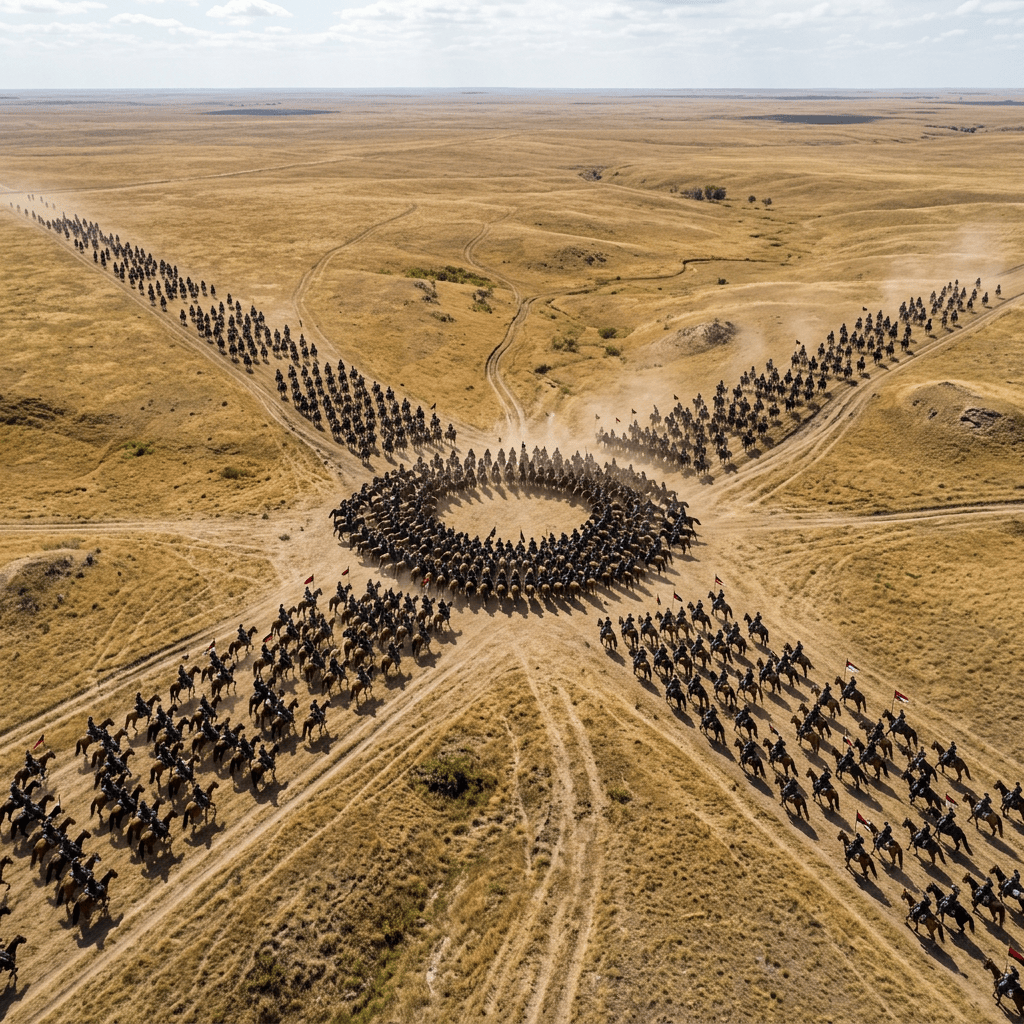
Hoka hey is a Lakota phrase, somewhat difficult to translate. In a military sense it most likely means “Let’s go!” in English, or “Los” in German. For Lakota warriors encamped on a non-descript tributary in southeastern Montana on June 25, 1876, the famous phrase took on a special meaning.
Without warning, United States Army cavalry troopers of the 7th U.S. Cavalry Regiment under the command of Lt. Col. George Armstrong Custer suddenly appeared south of the huge camp on the Little Big Horn River. In full battle deployment a battalion of the 7th led by Maj. Marcus Reno thundered toward the Hunkpapa tipis on the south end of camp, destroying the tranquility of a sleepy summer afternoon.
Reno’s assault was the opening phase of the Battle of Little Bighorn, the most consequential battle of what became known as the Great Sioux War. When the day was over, the vaunted 7th Cavalry Regiment would be shattered and its commander along with hundreds of his soldiers would lie dead around him on a sun-swept knoll east of river.
Although the assembled Lakota, Northern Cheyenne, Arapahoe, and Dakota people were aware that U.S. soldiers were campaigning against them, they did not expect to fight Custer’s regiment that day. Reno’s attack achieved complete tactical surprise.
Despite the gift of tactical surprise, Reno’s undersized battalion of roughly 100 troopers, Arikara, and Crow scouts was a grossly inadequate force to take on the massive camp which had swelled to estimates as high as 10,000 with anywhere from 1,500 to 4,000 battle-tested and willing warriors.
Reno’s wing was part of Custer’s hastily conceived battle plan that day. Custer’s typical aggressiveness took over when Crow scouts spotted the giant encampment that morning. An overnight forced march had placed the 7th on the eastern flank of the camp, and Custer was ready to attack, despite dire warnings from the scouts about the massive size of the camp and its willingness to fight the soldiers. The warnings are legendary and true, as is Custer’s cavalier dismissal of their significance.
Custer had many personality flaws, but as a cavalry commander he was a courageous and fearless fighter, many would say reckless. His traits served him well during the U.S Civil War when his leadership and swagger were valuable in instilling confidence in union troopers initially overmatched against Confederate cavalry. But on this fateful day in June 1876 Custer’s bravado led him into a fight his sterling regiment could not win.
Custer’s plan was flawed. It was based on outdated intelligence and his estimate of the usual behavior of plains tribes when attacked. Custer expected the warriors to flee under his assault so he devised a hasty hammer and anvil approach with Reno’s battalion as the hammer driving into the camp from the south while his battalion formed the anvil and would circle to the north to ensnare the fleeing villagers in a trap. Custer was wrong. His estimate of the size of the camp and its ability to match the combat power of the regiment were fatally flawed.
To make matters worse, Custer had sent a third battalion under Capt. Frederick Benteen on a scouting mission to the south along the river further dividing his inadequate force. The Prussians military philosophers knew that no tactical battle plan survives initial contact with the enemy and Custer’s flawed plan quickly devolved into a fight for survival once the massive camp was roused into battle fury by Reno’s charge from the south.
Possibly stunned when he saw the size of the camp, Reno halted his charge and his dismounted troopers formed a battle line and began firing their 45-caliber carbines toward the village. Their fire was destructive and deadly, causing many early casualties in the Hunkpapa tipis, most notably Lakota warrior Gall’s wife and children. This murderous fusillade understandably enraged the warriors who responded with a furious counterattack that swelled around the trooper battle line, collapsing it and causing a wild retreat back across the river toward a low hill to the east where the men formed a defensive perimeter. The mostly Lakota warriors drove the panicked troopers across the river where desperate hand-to-hand combat caused dozens of trooper casualties before the soldiers rallied and formed a defense.
Still unaware of what was happening in the south Custer ordered a foray down to the river where his scouts first ascertained the size of their opponent’s camp. Reconsidering his initial plan, Custer dashed off a quick note to Benteen to rejoin the regiment in support of the attack. Custer’s note is the only written evidence that survived that day and it shows that the commander was beginning to understand his predicament.
What happened after that is not clear, but Custer’s battalion never crossed the river and ended up on what became known as Last Stand Hill in a futile attempt to survive. The north end of the camp consisted of Northern Cheyenne and Arapahoe allies of the Lakota. Lakota and Cheyenne were unusual among plains tribes for their long alliance, and the presence of Arapahoe and Dakota warriors added weight to the force.
As Custer’s battalion neared the river, the Cheyenne warriors responded fearsomely in defense of their families who were hastily sent to shelter in the hills to the west. The Cheyenne warriors bravely rallied to drive the soldiers back, taking many casualties in the process, but their desperate assault took from the soldiers any offensive momentum they had and forced them onto the defensive, a defense that could not withstand the growing weight of the warriors’ response which was building inexorably as more warriors rallied to defend the camp.
Custer’s poorly planned attack was now in tatters, with his two wings on the defensive and fighting for their lives in isolated groups in the hills to the east of the river. With the two groups of soldiers isolated, the Lakota warriors who were besieging the remnants of Reno’s withered command now shifted their assault to Custer’s force to their north. At this point, probably less than an hour into the battle, the size and combat power of the opposing forces became utterly decisive.
The 7th was massively outnumbered, and the warriors possessed a panoply of firearms augmented by carbines and ammunition captured from the soldiers already killed in action. Fully aware of the mortal danger the troopers posed to their families the Lakota, Dakota, Cheyenne and Arapaho men fought with a merciless fury that swamped the defensive attempts of the soldiers. As the fight developed to its infernal conclusion, the afternoon heat and dust lent a terrible atmosphere as soldiers and warriors clashed in close combat. Lakota teenager Black Elk has described in his memoire the awful din of the battle as the gunfire, shrill eagle bone whistles of the warriors and the shrieks of pain and terror washed over the combatants on Last Stand Hill.
Despite Benteen’s battalion returning to the battlefield at Reno’s defensive position, it was far too late for Custer’s command which was nearing extinction to the north. Custer’s troopers on Last Stand Hill were surrounded and there was no escape as the warriors moved in to end their resistance with traditional war clubs and lances. For the most part the soldiers fought cohesively as long as possible before finally being subdued. Some committed suicide, while others tried to run away, only to be chased down and clubbed to death.
Once the warriors had killed Custer, his fellow officers, and troopers, they again turned their attention to Reno and Benteen to the south. But the terrified troopers there had erected a relatively strong defensive position and were prepared to fight off any attack under Benteen’s steady leadership.
The terrible day ended as the adrenaline ebbed from the warriors who were flushed with their decisive victory over the hated soldiers who had threatened and killed their family members in an unprovoked attack. But their excitement and joy were tempered by the remorseless nature of the combat. Young Black Elk described his horror at watching his arrow kill a trooper and how the man’s death throes caused his appetite for battle to wane. Still, there were more troopers on the battlefield and the danger they posed was not yet fully neutralized. But with the remaining soldiers contained behind their defensive breastworks, the warriors slowly retired from fight and left the field to the women who exacted their revenge on the soldiers’ corpses with terrible mutilations.
The next day, the camp was packed up, and the assembled tribes left the area as more soldiers under Gen. Alfred Terry approached from the north, much to the relief of Reno’s and Benteen’s men who had spent a restless and fearful night on the hill above the river. The Battle of Little Big Horn was finished.
Despite their absolutely conclusive victory June 25, 1876, many of the tribes’ elders, including Hunkpapa spiritual leader Sitting Bull, knew there would be more soldiers to fight and more battles ahead. The loss of several hundred troopers and their famous commander shocked the military establishment in Washington, an ominous sign for the tribes.
The war would go on and as Washington mustered more soldiers, eventually the tribes would succumb, ending their roaming life on the prairie. But on the hills above the Little Big Horn River, the warriors had won the day and Custer and his men had paid the ultimate price for the miscalculations.

